



[Tom Biederbeck] Since the Academy of Art University’s School of Graphic Design began requiring students to prepare a book-format portfolio in order to graduate, more design schools around the nation have adopted the practice. Now, tools available to students for publishing their portfolio books are allowing them to affordably present their work with new features. Recent graduates like Adam Deleeuw are employing Blurb to their benefit to produce attention-capturing covers and graphics and a range of paper, printing and binding options.
Deleeuw, a 2011 Academy BFA grad in Graphic Design, is a multitalented artist who started out studying fine art, switched to advertising (specifically copywriting) and then landed in graphic design. His journey exemplifies the full range of his interests in visual, typographic and pop culture communication. “I love very bold, graphic imagery, and graphic design allowed me to express my visual style in a better way than fine art could,” he says.
Deleeuw learned of Blurb in a class taught by Mary Scott, executive director of the Academy’s Graphic Design School, and he was intrigued. Producing his book via Blurb made it possible for him to evolve his creative instincts while capitalizing on his interest in producing visual artifacts, something that’s grown as he pursued his studies at the university. “I used to look at something and say, ‘Wow, that’s really pretty.’ Now, with my education and through so many years of projects, it’s much more satisfying to create something tangible than it ever was for me before.” The Blurb format encourages his creative process by enabling levels of customization and personalization … which Deleeuw took full advantage of in his portfolio.
Deleeuw’s Blurb book reflects his growth as a visual communicator, with separate sections portraying his work. A personal project to create a complete film festival campaign — with posters, catalogs, promotional items, tickets, DVD cases and more — is a case in point.
“We had to pick a director and six films and find a unifying theme within those films,” he recalls. “I picked Mike Nichols; my festival is called Drowning in a Fishbowl: An Insider’s View of an Outsider’s Perspective in the Films of Mike Nichols.”
Deleeuw’s book also features a group project, shown above, this time centered around packaging: rebranding Costco’s house brand Kirkland. “For a lot of the stuff, we used full image-wraps for the packaging — you see the products, you see the texture. We invented a new packaging system for apparel. They’re clear tubes, so you can see what you’re getting.”
Of course the book includes the kind of work all graphic designers love to do, like the clever printed poster below that will literally “save your life.”
The work makes it obvious that Deleeuw loves “colorful, bold, edgy” graphics … and like most designers, he cherishes print. “When you hold something printed, even if five million copies were made, it’s still there to be held in your hand and develop a relationship with,” he says. “But today you need to take a different route with printing techniques to capture someone’s attention.”
The Blurb format put all of those techniques at Deleeuw’s fingertips, lending his book extra impact, he says. The short sheets he used at strategic spots in the book are examples of the customization that’s possible. Another example: “Using Blurb offered me the option of using an image wrap on the cover, versus a standard book cloth, adding a unique quality to my portfolio. Blurb is also very hassle-free. All the specifications are very clear, and you use a PDF template loaded into InDesign, which makes Blurb easy to work with. Tech support is available, but I didn’t need it.”
There are numerous production and efficiency advantages. “I was able to have six copies printed and bound for less money than the cost of a single case-bound book,” he says. “The quality of the printing and binding is outstanding. They say there is a 10-day turnaround, but I ordered my books on a Wednesday night and received them the following Tuesday morning.”
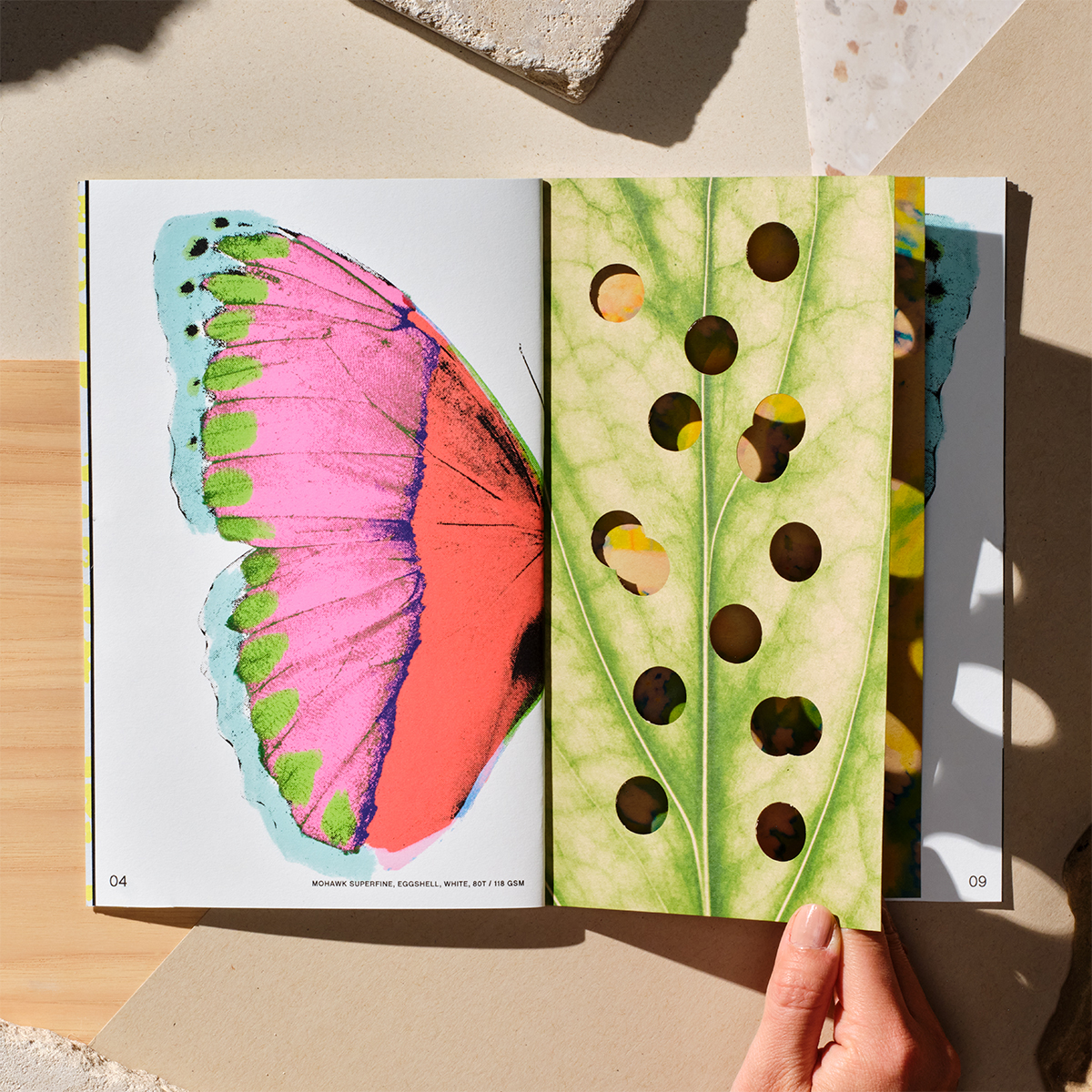
Blurb offers a Proline binding option, which Deleeuw selected. A big attraction was the ability to choose from high quality Mohawk papers. “I chose to print on uncoated — Mohawk Superfine Eggshell Ultrawhite … and this paper is lovely!” he says with obvious enthusiasm. Other Proline options include choosing the color of end sheets, alternatives for book cloth with a slip cover [you can see Deleeuw’s slip cover in the image that leads this article] and more.
Blurb put Deleeuw into a realm of choices that make any print-loving graphic designer joyful. “Before I received my portfolio, I looked through the digital version of it and thought it looked great … but it’s nothing compared to the impression you get in a real, printed book.”
For Deleeuw, the experience of producing his book with Blurb was a perfect marriage of modern technology and traditional communication … and it enabled him to pull together the knowledge he’s gained in school. “For print, it’s important to envision the final product and anticipate the necessary steps to bring it into reality. That’s one of the biggest things I’ve learned at the Academy: how to make things. To know you can produce a full-length book and put it on the table in 15 weeks is truly awesome.”
View Adam Deleeuw’s work online here. To learn more about the Academy of Art University’s School of Graphic Design, we recommend the excellent blog 79NM.com.