




[Alyson Kuhn] The new case statement for the University of San Francisco(USF) perfectly balances sense of purpose with sense of place. The smart messaging and great photography on the cover carry through a dozen interior spreads and five clever short sheets. We chatted with David Macmillan, of USF’s Office of Communications & Marketing, and Kit Hinrichs of Studio Hinrichs, about their collaboration. And because we are quasi-insatiable, we called printer Kim Blanchette in Vancouver, B.C.
Printer Kim Blanchette: “The left-hand page is printed with a single hit of Blanchette Black, a proprietary mix developed for us 20 years ago.”
What is the purpose of this piece?
David Macmillan: Our development office will use it to introduce new potential donors and foundation funders to the university. The president’s office will also use it at several high-level events throughout the year. We call it a case statement. Universities commonly use annual reports to introduce folks to the school, but we do not do one every year.
Kit Hinrichs: If the university were a corporation, this would be their capabilities book. It is not at all a traditional student view book.
Associate Professor Corey Cook in the rotunda of San Francisco City Hall. The back of the short sheet sums up Cook’s role at USF and his thoughts on the school’s role in the community.
I have read, and enjoyed, the entire book. I would describe the perspective as very outward-facing. Was that the plan from the beginning?
DM: We have our own internal design group here, and we do our own admissions materials in-house. We have several full-time designers, and their work has won a gold award in our district. This piece, however, called for high-level thinking, to tie it directly to our messaging platform and our branding attributes, including our new tagline and updated logo. Studio Hinrichs had recently completed our new identity, and this book is the continuation of that process. Kit also brought in Linda Peterson of Peterson Skolnick & Dodge to work with us.
Professor Christine Yeh in front of a construction barrier on campus. David Macmillan comments: “The head of our Art and Architecture Department has come up with several artistic student projects for the wall. This section is a periodic table of the majors we offer. In other sections, students have installed speakers and also some vertical plant walls.”
KH: Peterson Skolnick & Dodge is a wonderful team of strategists who also consult with groups about messaging — how to position a company with words. This piece was not intended to be a tome. We had just finished the new identity for USF, and the book provides a fresh overview of the university. It introduces the new identity via its philosophy of “Change.” It was an integral part of the university’s rebranding. We’ve worked with PS&D for over 25 years.
Kit Hinrichs: “Each of Andy Goodwin‘s major photos is followed by a spread of bite-sized facts providing more detail about unique aspects of the USF community. This spread highlights student life — academic programs, faculty, the facility and sports teams.”
Native San Franciscan Father Stephen A. Privett, president, University of San Francisco, on campus. His short-sheet quote: “USF’s goal is to cultivate a ‘we’ perspective in the midst of a ‘me’ culture. In that regard, we are truly a counterculture enterprise.”
A piece like this is a major investment. How do you think about its relative value?
DM: Our president has three more years in his current term. We wanted to invest in a piece that will last through his presidency. We will probably undertake a capital campaign thereafter, and a new piece will be called for by then.
KH: The university is an ideal client not only in terms of understanding what it takes to put a piece like this together, but in terms of first realizing “we need this” and then in appreciating its value. USF considers the city a classroom extension within the university, and they gave us the creative leeway to show that. Andy Goodwin was able to shoot the major photographs on location around the city. In the end, we feel it accurately represents who they are.
USF student Camille Watts, class of 2013, at the Ferry Building on San Francisco’s Embarcadero. Kit Hinrichs: “I had thought of shooting her on the ferry, coming in toward the Ferry Building, but the tower would have been dwarfed by the towers that surround it now.”
It’s a pleasure to hold this book and turn the pages. Can we talk about its feel?
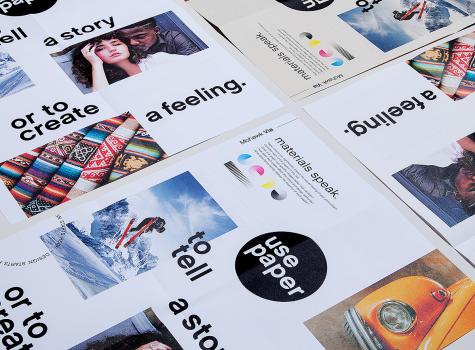
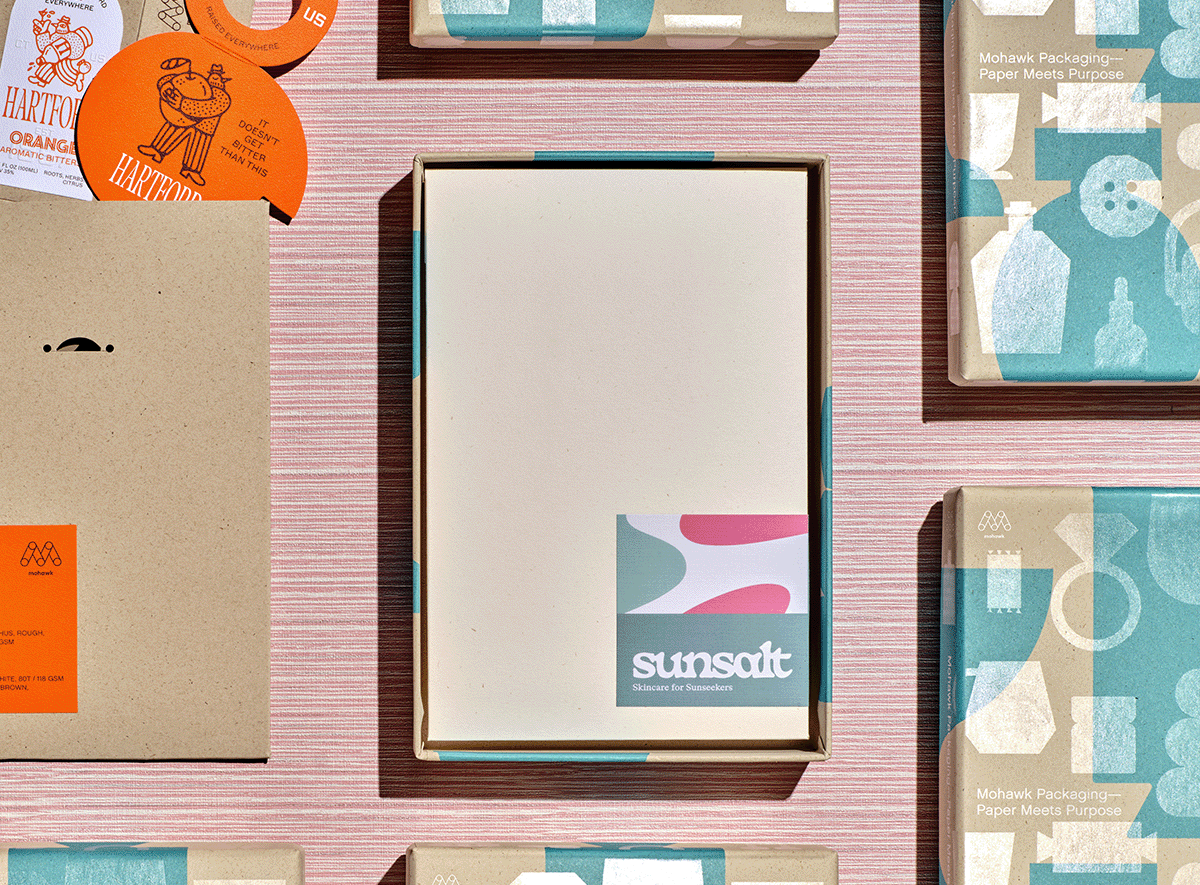
KH: This was one of the times when an uncoated look is quite appropriate. Kim Blanchette recommended Mohawk Via, which we’ve used before on other projects at Blanchette Press.
Kim Blanchette: We are big fans of Via. We probably print 90% of our uncoated work on Mohawk.
The short sheets, to me, seem fraught with the potential for press and bindery fiasco. Were they problematic?
KB: No question about it, this was a challenge in terms of printing and binding. Our San Francisco representative, Ken Clark, worked closely with Kit to prepare the files for printing. The design of the project did not allow for simply inserting the sheets on the binder after they’d been printed by themselves. They are printed on a form with the full pages, but they are on the opposite side of the sheet, so the colors have to be 100% spot-on, and there’s ink dry-back to allow for. The short sheets are scored and folded, and need to align as close to perfectly as possible with the image beneath.
USF Trustee Emeritus Alfred Chuang, class of 1982. On the back of the short sheet, Chuang speaks about his $2.5 million gift to create and endow the Kudlick High-Tech Interactive Classroom, named for his mentor, former computer science chair Michael Kudlick.
Is there anything you’d like to share about the velvety blacks and vibrant colors? To me, the fact that everyone’s hair looks so, well, alive is a big testimonial to the print job.
KB: Thank you. We don’t use conventional inks any more. We use a custom formulation, a UV hybrid, all the time. We think they look better, and they are easier for us to handle. They are faster to dry, and there are zero VOCs. The fact that we have less paper waste also means less environmental impact. By the way, we did put a light lick of satin varnish on the cover and the backs of the short sheets.
Philanthropy facts follow the profile of Alfred Chuang. Kit Hinrichs: “All the statistical information relating to this part of the case statement is presented here. Takayo Muroga, a lead designer in our studio who had worked with us on the identity, made the statistics so enticing by combining different typography at different scales.”
All photos: © 2012 StudioAlex. Statistical spread scans courtesy of Studio Hinrichs.


Comments (1)
I have seen some of their very catchy and wonderful ads on Muni shelters and this is fascinating. Great job!