[Alyson Kuhn] The Fifth Edition of the American Heritage Dictionary is my current favorite big book. The staff at publisher Houghton Mifflin Harcourt (HMH) refers to the new edition, more than a decade in the making, as AHD5. I plan on calling mine Houghton’s Fifth. (The Third Edition, which has resided on my swiveling dictionary stand for two decades, has just been retired to the reference bookstand in my office.) I recently took a behind-the-scenes tour of the new dictionary with Clif Stoltze, whose studio designed the cover and the letter openers, and Michaela Sullivan, creative director at HMH.
I admit to having “skipped” the Fourth Edition of the dictionary, so the notion of color illustrations is new and exciting to me. Can you give us some historical perspective?
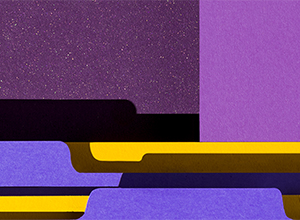
Michaela Sullivan: We introduced full-color, CMYK art for the Fourth Edition. We chose a dedicated shade of blue for entry words so they pop on the page, making it easier to find the word you’re looking for. We selected a slightly different blue for the Fifth Edition. The Fourth and Fifth Editions also have full-color illustrations for the 26 letter openers. For the Fourth Edition, we researched art for the letter openers in-house, based on letterforms found in fine art, historical imagery and the vernacular. For the Fifth Edition, we asked Stoltze Design to create a new, distinct set of letter openers.

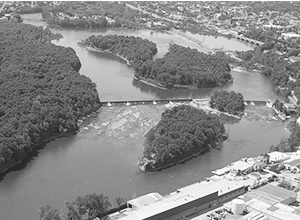
Marquee, Radio City Music Hall. “Opened in 1932, Radio City Music Hall is a landmark in New York’s Rockefeller Center” (from AHD5).
Clif Stoltze: We designed only the cover for the Fourth Edition, which we based on the system we had developed for the secondary series, such as office, high school, college and medical dictionaries. When we were asked to work on the letter openers for the Fifth Edition, we proposed using letterforms from Americana signage, products and printed ephemera. In addition to researching the images, we designed the banner treatment, which bleeds to the edges of the page, helping the reader quickly find the beginning of each letter section.
Original manuscript, Constitution of the United States of America. “Drafted in Philadelphia in 1787, the Constitution begins with the words We the People” (from AHD5).
The captions under each image are so informative — I love knowing exactly what I’m looking at. And I’m curious about putting a large full-bleed image on dictionary paper. Was this tricky or costly?
MS: Actually, it wasn’t. The paper used for the Fourth Edition was sufficiently opaque, so we didn’t need to increase the weight. Because the dictionary is printed on a web press, the bleeds are not an issue. Quad/Graphics, our printer, also has the equipment to cut and place the thumb tabs.
CS: We wanted the image introducing each letter to be visually compelling and to evoke its use in everyday life. We tackled the banner design and photo research in the summer of 2009. The following summer, our team, including designers Lauren Vajda and Katherine Hughes, began the extensive cover explorations.
The half-jacket protects the white linen cover and continues the design. The copper letters of dictionary are foil-stamped on both surfaces.
Did the idea of putting dictionary running down the cover rather than across it spark debate?
CS: Fortunately not. It’s a simple design idea, but it became a strong branding device that helps it stand out from the typical dictionary design conventions. We did go back and forth about selecting a small image to put inside the o to reference the color illustrations within. Ultimately we settled on a detail of the American Heritage eagle.
Did HMH consider not doing a fifth print edition?
MS: No, not really. As Steve Kleinedler, the executive editor for the dictionary group, likes to say, “There is a place for electronic and a place for print, and some people prefer one or the other but there is a use for both.” We engaged a market research firm, and they confirmed that people who own a dictionary relate to it. The dictionary speaks to who they are. The high quality of the dictionary indicates that customers who own it appreciate words and learning about words.
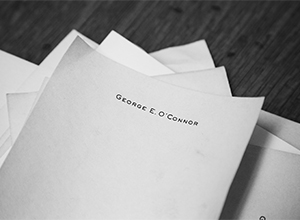
Manuscript, Gettysburg Address. “This draft of the 1863 Gettysburg Address, written in Abraham Lincoln’s hand, is archived at the Library of Congress” (from AHD5).
And there is also an electronic version?
MS: Yes, there is. The purchase of the print dictionary includes the option to download a copy of our app for free, on either the iTunes or Android platform. The content of the app is the same as the print dictionary. What you can’t get, of course, is the immersive experience of browsing the page, getting lost in the stories of the words that surround the word you’re looking for — and, of course, seeing the illustrations in the columns.
Glass-topped keys, Royal typewriter. “This typewriter was manufactured in the 1920s by the Royal Typewriter Company of Hartford, Connecticut” (from AHD5).
AHD5 © 2012 Houghton Mifflin Harcourt Publishing Company
Alyson Kuhn also spoke with executive editor Steve Kleinedler and Margaret Anne Miles, the chief art researcher and illustration guru at HMH. Later this month, Felt & Wire will report on where the new words and pictures in AHD5 come from.


Comments (2)
Great article! In complete agreeement: ‘There is a place for electronic and a place for print, and some people prefer one or the other bet there is a use for both.’ I love an online dictionary, but for me, nothing matches the experience of wandering through the actual dictionary pages. Looking forward to seeing this ‘colorful’ version.
“The high quality of the dictionary indicates that customers who own it appreciate words and learning about words.”
Absolutely true! Thank you, AHD5, for turning the simple act of looking up a word into a creative experience. And thank you, Alyson, for a wonderfully interesting piece.